
ECLIPSE: A Spacecraft Rendezvous Trajectories Dataset with Controlled In-Orbit Lighting Conditions
Nidhal Eddine Chenni, Arunkumar Rathinam, Abid Ali, Djamila Aouada
2026
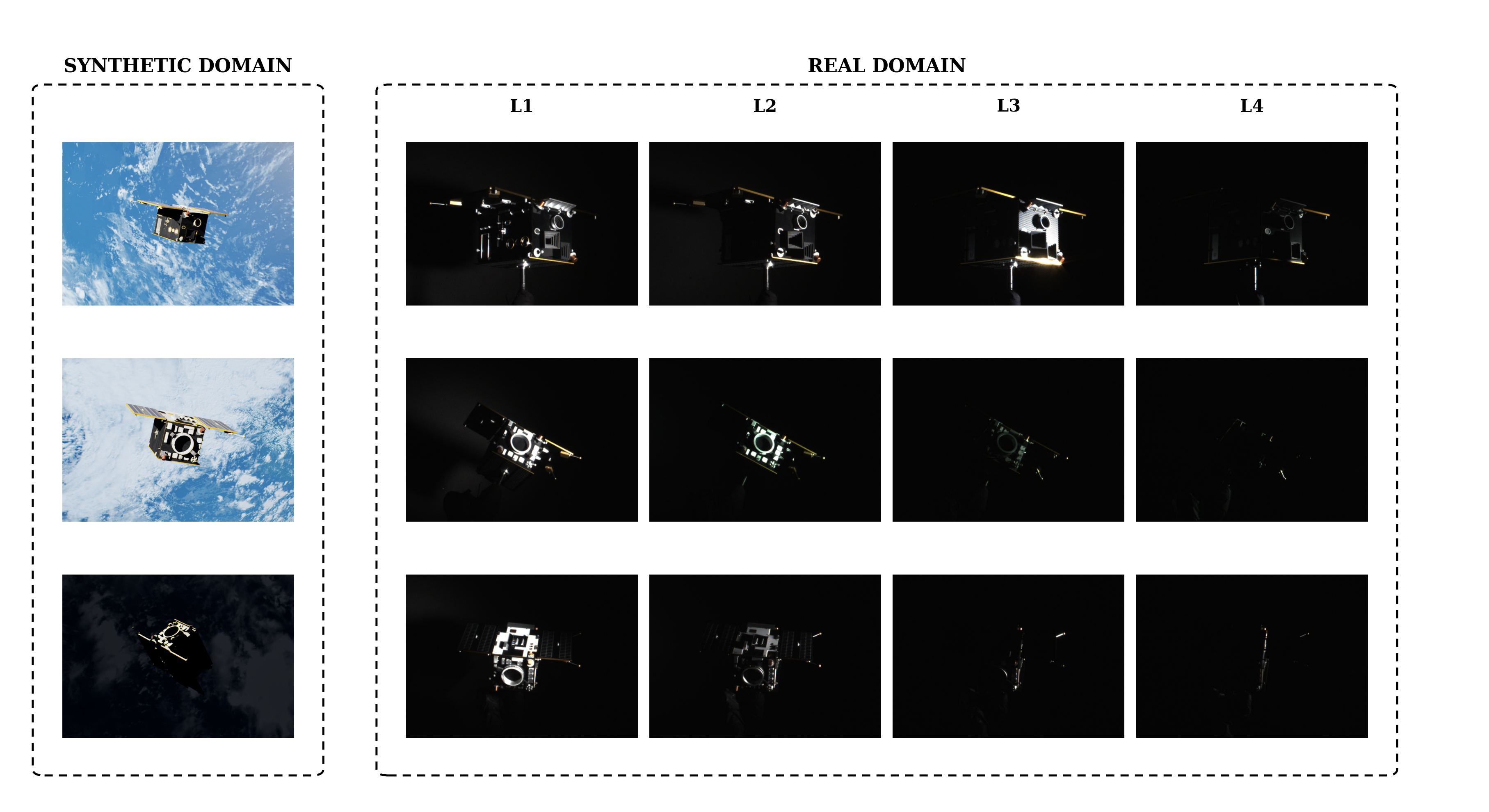
Abstract
Deep learning has become the dominant paradigm for vision-based spacecraft pose estimation, where models are predominantly trained on synthetic data due to the prohibitive cost of acquiring real in-orbit imagery. When deployed, these models suffer significant performance degradation due to the sim-to-real domain gap, which existing benchmarks address by pairing synthetic training data with Hardware-in-the-Loop (HIL) real imagery. Yet a critical factor remains consistently overlooked: in real orbital scenarios, illumination varies with the spacecraft’s position along its orbit, inducing severe appearance shifts that existing benchmarks neither control nor study. We introduce ECLIPSE, the first benchmark designed to isolate illumination as an independent experimental variable. ECLIPSE pairs a large-scale photorealistic synthetic training set with a fully labeled HIL evaluation set of 14 approach trajectories, each replayed identically under 4 controlled lighting conditions, enabling rigorous evaluation of illumination-robust and domain-adaptation methods. Through this controlled design, our experiments confirm that lighting is the dominant driver of the sim-to-real performance gap in spacecraft pose estimation.